Tracing the Contours of Art, Science, Technology and Cognitive Neuroscience
Category: Works on Paper
This section showcases works on paper. Since the purpose of this website is to archive Amy Ione’s work from the 1970s to the present, both successful and less successful work is displayed. For more information about any of the works, click on the caption below the painting or send an email.
May Day (Pluralism) is a layered image that uses ink and acrylic to explore how distinct elements can coexist in harmony. The crisp lines of ink meet the softer washes of acrylic, creating a dynamic surface that resists singular interpretation.
May Day festivals are usually celebrated on May 1, around halfway between the Northern Hemisphere’s spring equinox and midsummer solstice. The title reflects the painting’s theme and in it, diversity and multiplicity co-exist. Though small in scale, the work invites viewers to reflect on expansive ideas about dialogue, difference, and unity. Continue reading “May Day (Pluralism) (2020)”
This 1983 gouache and ink work, Ships, reads as a stylized boat within a rigorously geometric, almost architectural framework. Blending a medley of circles, arcs, and rectilinear grids, this small painting evokes a dialogue between a concrete subject (a ship and its masts) and an abstract system of colored shapes.
Painted in 1986, this work was ruined by a leaky roof about ten years after it was created. When it was on display it led to unusual encounters due to its perceptual resonance. They are too numerous and varied to record here.
The process used combined liquid acrylic paint overlays and ink.
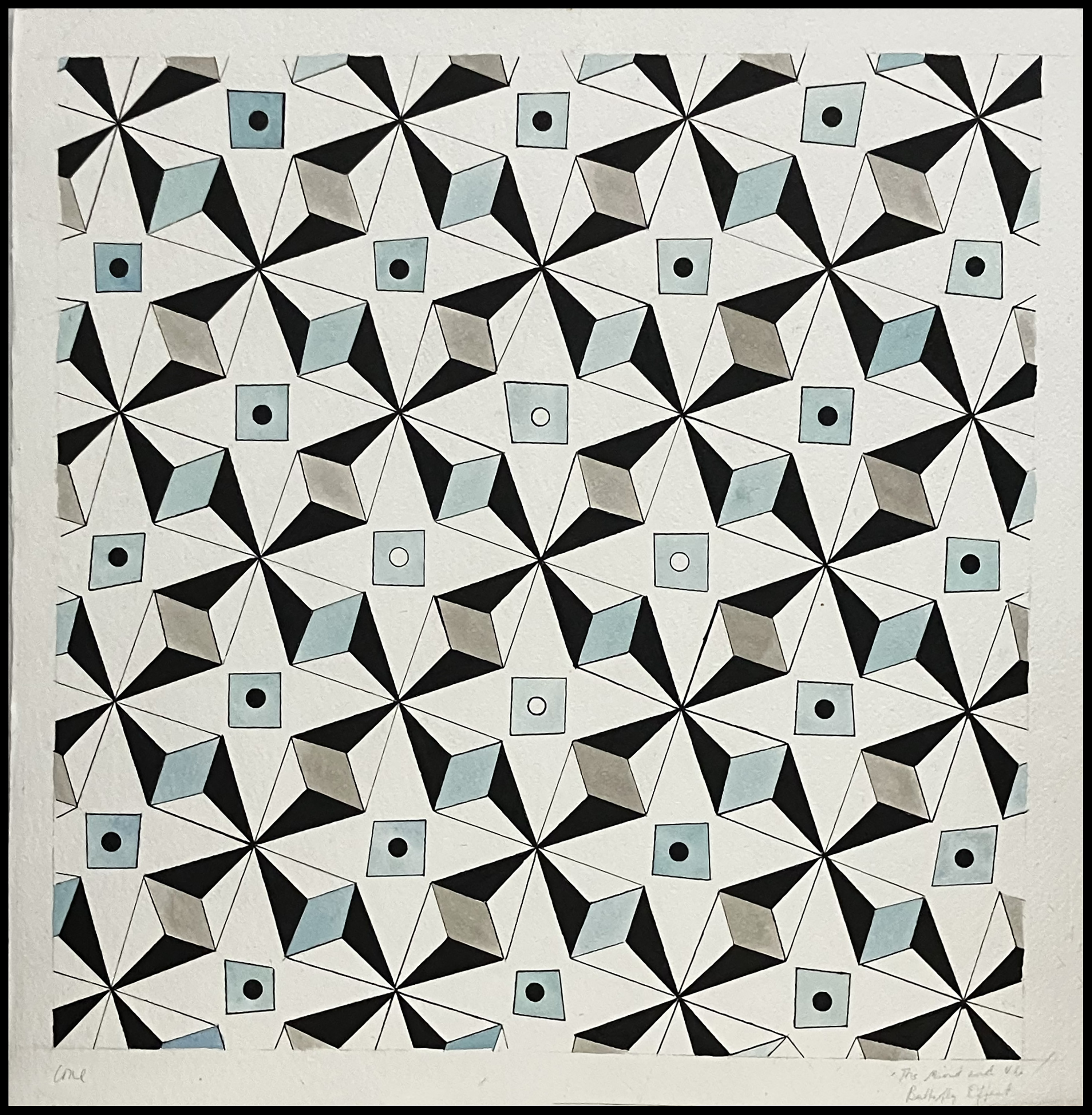
The Mind and the Butterfly Effect brings geometric structure into dialogue with the unpredictability that defines artmaking, cognition, and chaos theory. It takes it title (or conceptual cue) from the “butterfly effect,” the idea that minute variations in initial conditions can cascade into large, unforeseen consequences within complex systems. Initially, the composition reads as regular—anchored by a grid-like scaffolding and a disciplined sense of spatial order. Closer inspection, however, reveals subtle shifts in line weight, chromatic modulation, and the physicality of the ink and acrylic application.
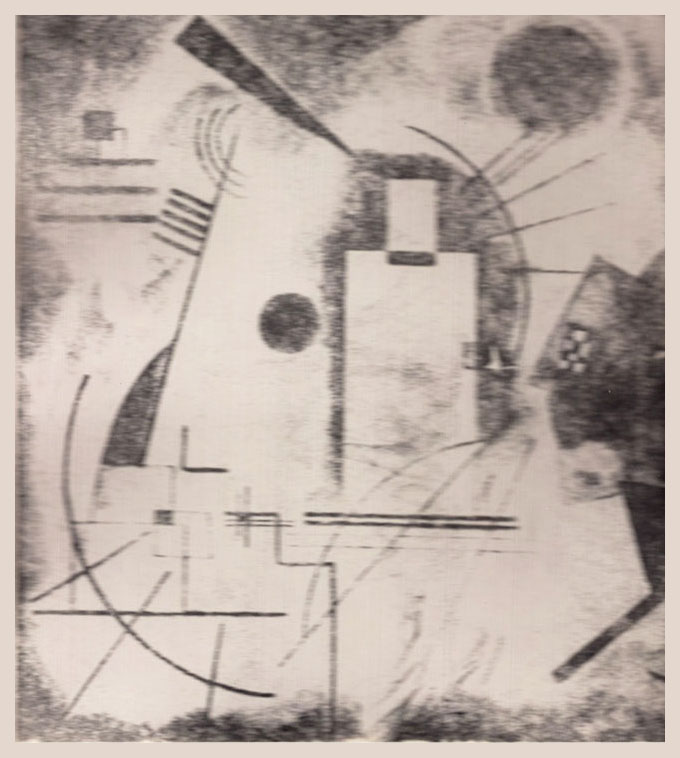
This monoprint is based on Kandinsky’s Yellow-Red-Blue (1925), now in Paris, at the Centre Georges Pompidou. Unlike the monoprint, Kandinsky’s painting’s geometry, color, flow, and abstract shapes are evocative of grapheme-color synesthesia. Indeed, it seems to suggest a person experiencing vivid ‘synesthetic’ imagery.
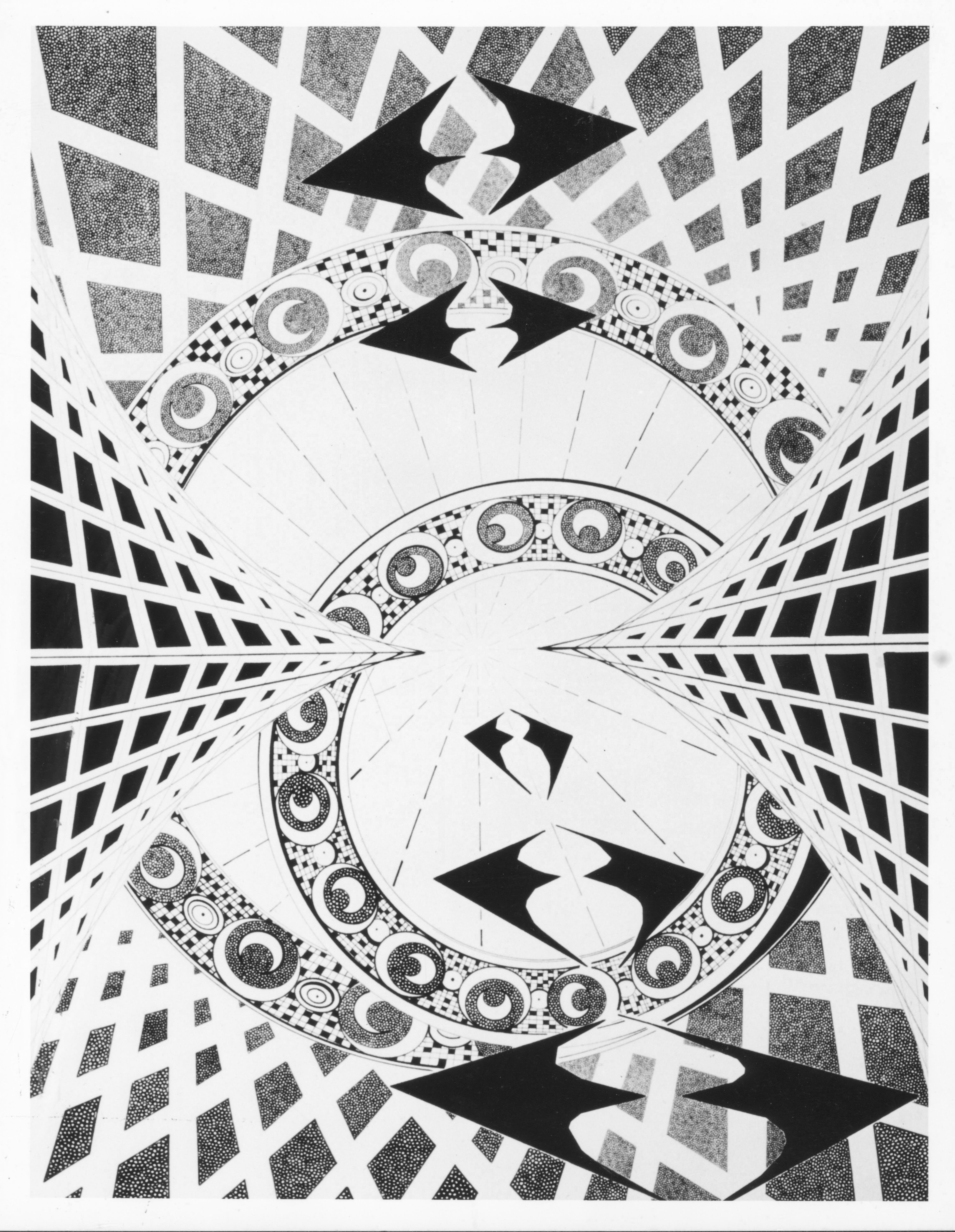
Alchemical Rending is an evocative composition that explores the intersection of geometry, symbolism, and perceptual inquiry through a tightly composed and meticulously executed ink drawing. The work features a central circular form layered with radial lines, checkerboard textures, and a pyramid-like structure, surrounded by concentric ellipses and rectilinear segments. This central motif is reminiscent of an alchemical diagram, thus the name. Here the central form serves to anchor the composition in a space where perception, pattern, and meaning interlace. Continue reading “Alchemical Rendering #1 (1981)”
A portable, intimate example of the artist’s work, this card reflects her interest in transformation and fluidity, with a design that feels both structured and spontaneous. Continue reading “Mutation Study Greeting Card (2019)”
Homage to Vermeer (2011) reimagines Johannes Vermeer’s The Art of Painting through a contemporary lens. Rather than replicating the Dutch master’s meticulous realism, the work translates Vermeer’s luminous interior into a modern idiom of layered color, flattened space, and pattern. By invoking Vermeer’s iconic meditation on the painter at work, this painting also places Ione’s practice within a lineage of artists reflecting on the nature of painting. Continue reading “Homage to Vermeer’s Art of Painting (2011)”
This drawing/painting was also known at Plato’s Cave when created. Like many artists, at that time I thought Plato was talking about artistic creativity when he introduced the Allegory of the Cave in the Republic. I removed the Plato reference when I realized that he had actually banned the artists from his Republic, disdaining their ability to convince people that mere “illusions,” were actually the Truth. Continue reading “The Artist as Creator #1 (Plato’s Cave)”