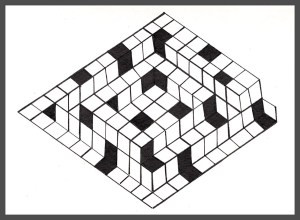
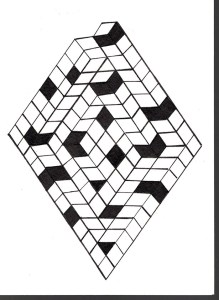
Cubistic (2017) is a Necker cube study. The work is a perceptual oil painting that explores visual ambiguity and cognitive interpretation through geometric abstraction. Its starting point was the concept of the Necker cube—an optical illusion first described by Swiss crystallographer Louis Albert Necker in 1832. Continue reading “Cubistic (2017)”
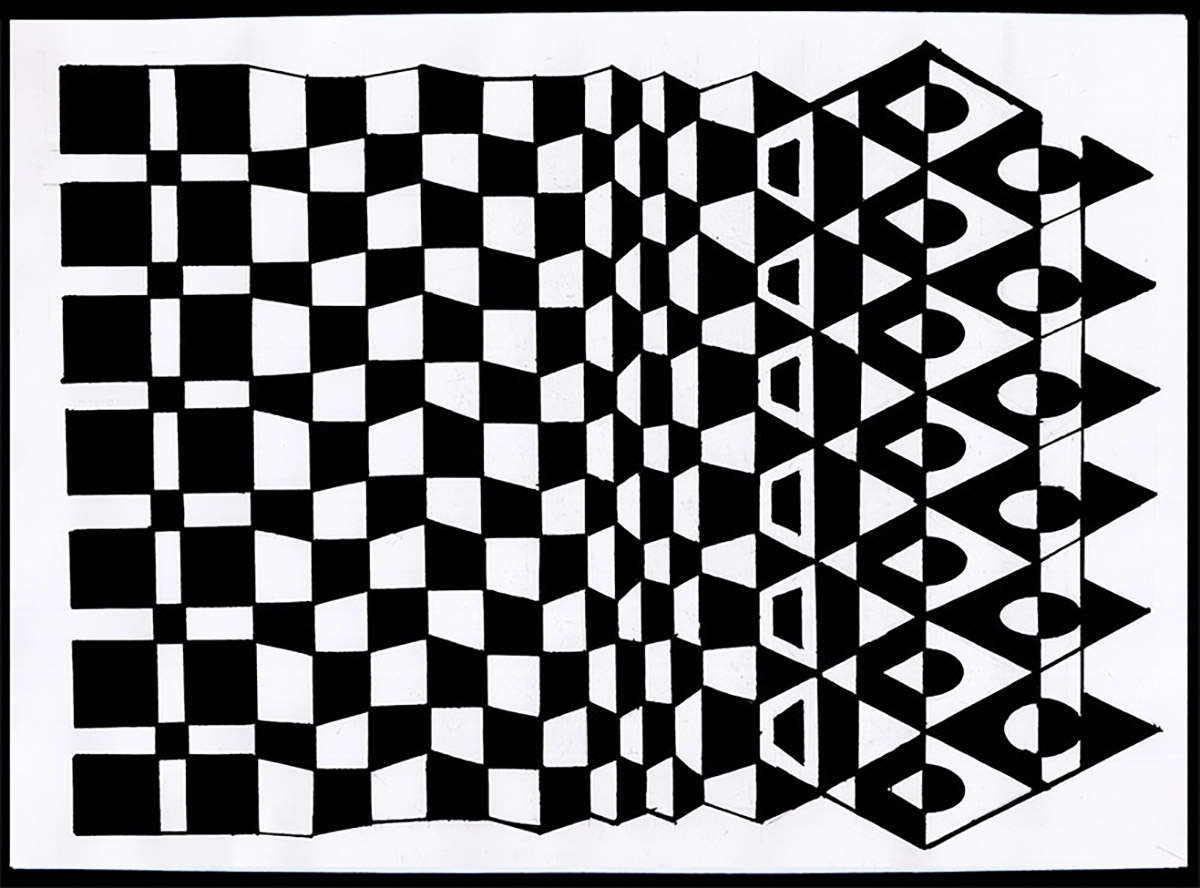
This small, intimate work foregrounds “mutation” as both subject and method. It began with a vertical line of squares and with slight changes on the vertical axis, the pattern was transformed into an open column of triangles at the end. Overall, the piece expresses a noticeable change in character, appearance, function or condition on a 2-dimensional plane; a metamorphosis that adds a perceptual dynamic to the black-and-white geometries. Continue reading “Mutation Study #1 (2018)”
The intention of this card was to use the fold as a line in presenting a formal and irregular composition. In this sense, it conveys something that is stochastic, which is defined as the property of being well-described by a random probability distribution. Continue reading “Stochastic Checkerboard (Greeting Card) (2017)”
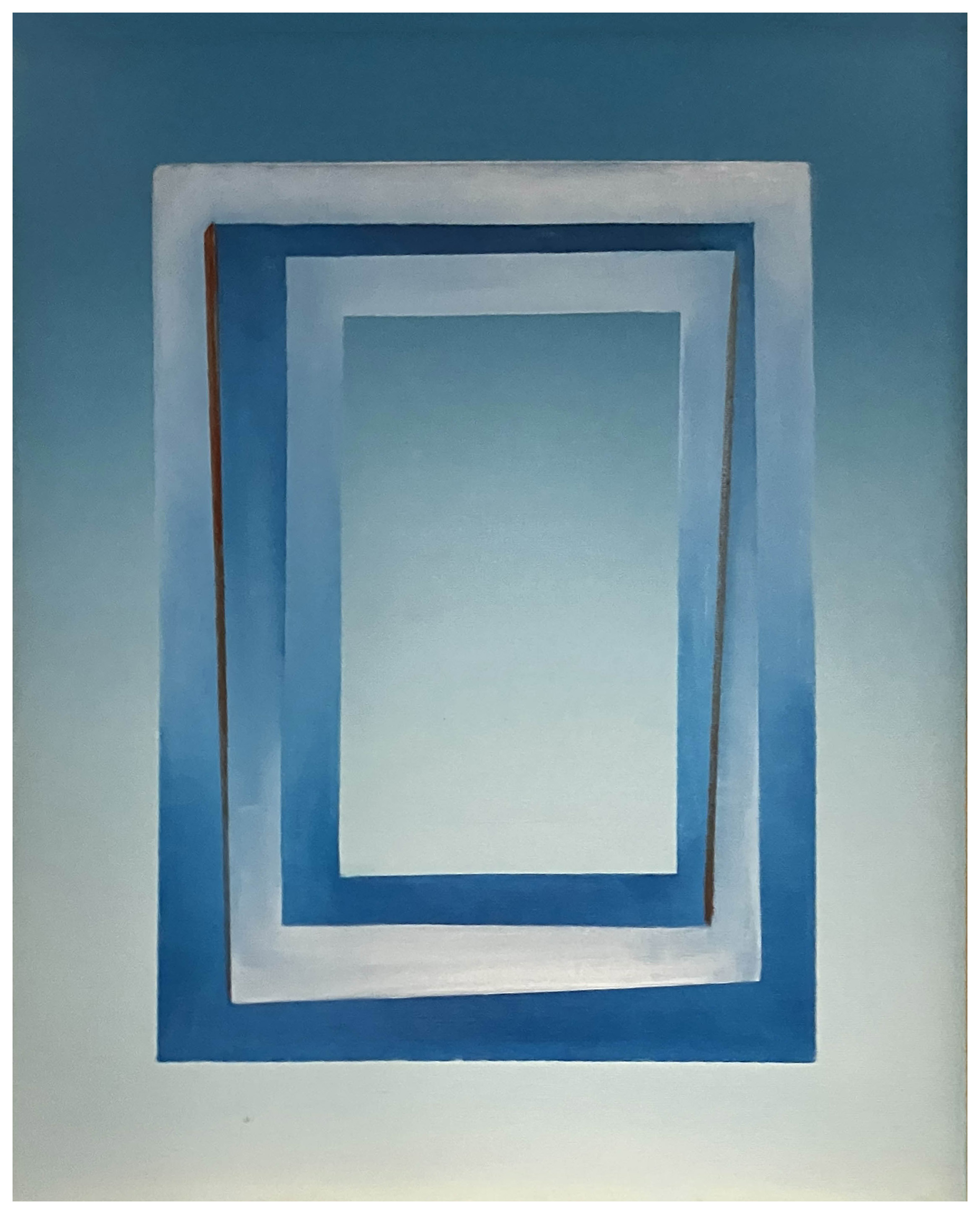
This painting is not concerned with representing an object but is instead staging how vision itself negotiates space. Thus, the viewer is invited to experience shifting depth cues (is the center receding or projecting?); transparency versus opacity; and the instability of alignment and orientation.
Perceptual Study: Rectangular Abstraction in Blue, White, and Red (2015) uses a limited palette and rectilinear structure to explore how viewers perceive depth, rhythm, and spatial tension within a flat surface. It belongs to my series of “perceptual studies,” works that treat the canvas as a site for investigating visual cognition rather than for depicting recognizable objects.
Penrose Tiling #2 features a tessellation of rhombus-shaped units arranged in a non-periodic pattern—one that resists repetition yet maintains internal logic. On this large, square canvas, the work’s mathematical underpinning becomes a vehicle for perceptual play, as the viewer’s eye navigates shifting planes and chromatic transitions. Continue reading “Penrose Tiling #2 (2015)”
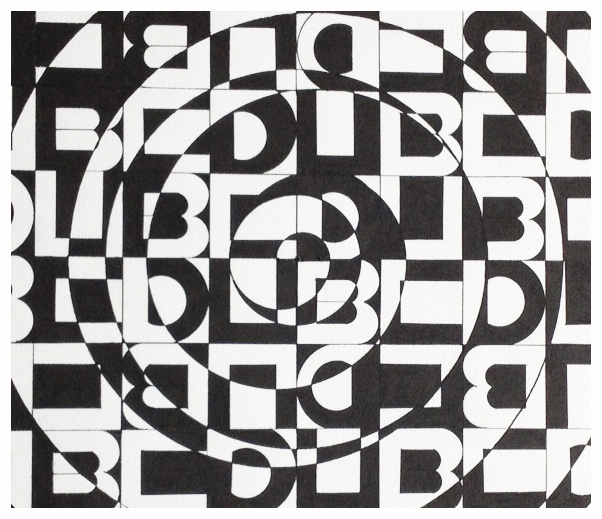
Like the 1985 Pisces, the concept behind this ink painting was a spiral constructed using a symbolic foundation, or more specifically in this work, a grapheme. A is the smallest functional unit of a writing system. As delineated here, the “C” stands for Christoper. Dub is a stand-in for “W”.