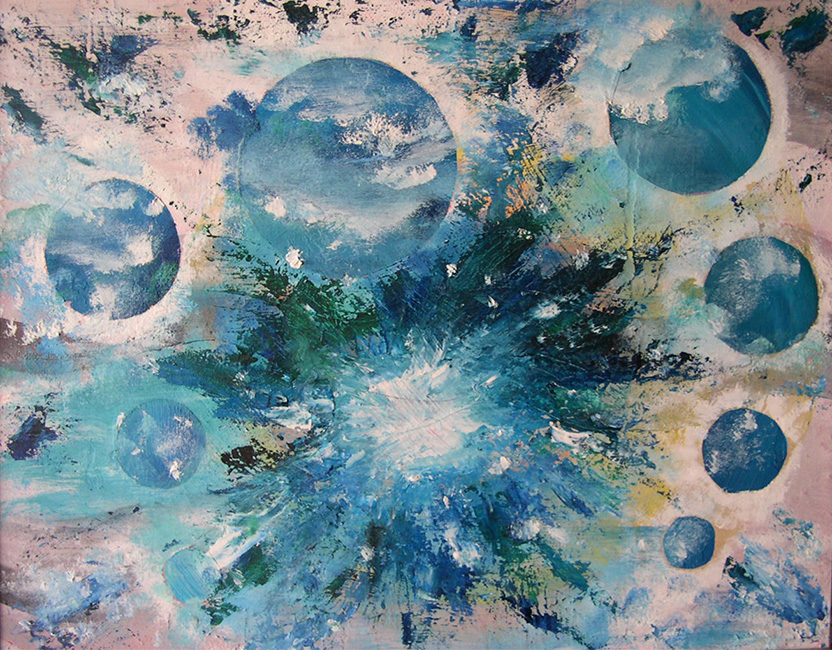
In Two, intersecting planes, arcs, and suspended spheres create a visual dialogue between balance and movement. The cool blue palette is energized by restrained orange accents, while layered transparencies and diagonal vectors suggest shifting spatial relationships rather than fixed forms.
Download book and exhibition reviews by Amy Ione at https://diatrope.com/book-reviews/. Topics include art, science, technology, cognitive neuroscience and more.
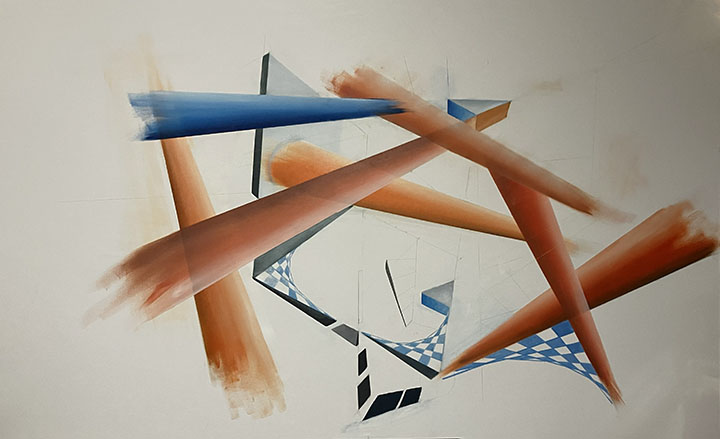
Cubistic (2017) is a Necker cube study. The work is a perceptual oil painting that explores visual ambiguity and cognitive interpretation through geometric abstraction. Its starting point was the concept of the Necker cube—an optical illusion first described by Swiss crystallographer Louis Albert Necker in 1832. Continue reading “Cubistic (2017)”
Homage to Cézanne is actually based on how his approach to perceptual painting influenced my work, not Cézanne’s style. The photographs below are reference photos used. The face top left in the large drawing is Cèzanne’s. The figures on the left are based on various photographs of him. The origin of the faces on the right is unclear at this point. Continue reading “Homage to Cézanne (1987)”
This Hyperbolic Surface sculpture was constructed out of paper in 2001 with Christopher W. Tyler.
Connecting regular 7-sided polygons (heptagons) together to form a surface results in a geometry that cannot exist in flat (Euclidean)
space. Instead, it creates a regular tiling of the hyperbolic plane. Specifically, the arrangement where three heptagons meet at each vertex
forms the heptagonal tiling with Schläfli symbol. Continue reading “Hyperbolic Surface by Christopher W. Tyler and Amy Ione”
Begun in the early 2020s, when people were increasingly talking about AI. The AI concept was an appealing starting point because the AI painting of Amy Ione is not at all based on artificial intelligence. Continue reading “Unfinished: About AI (Amy Ione)”
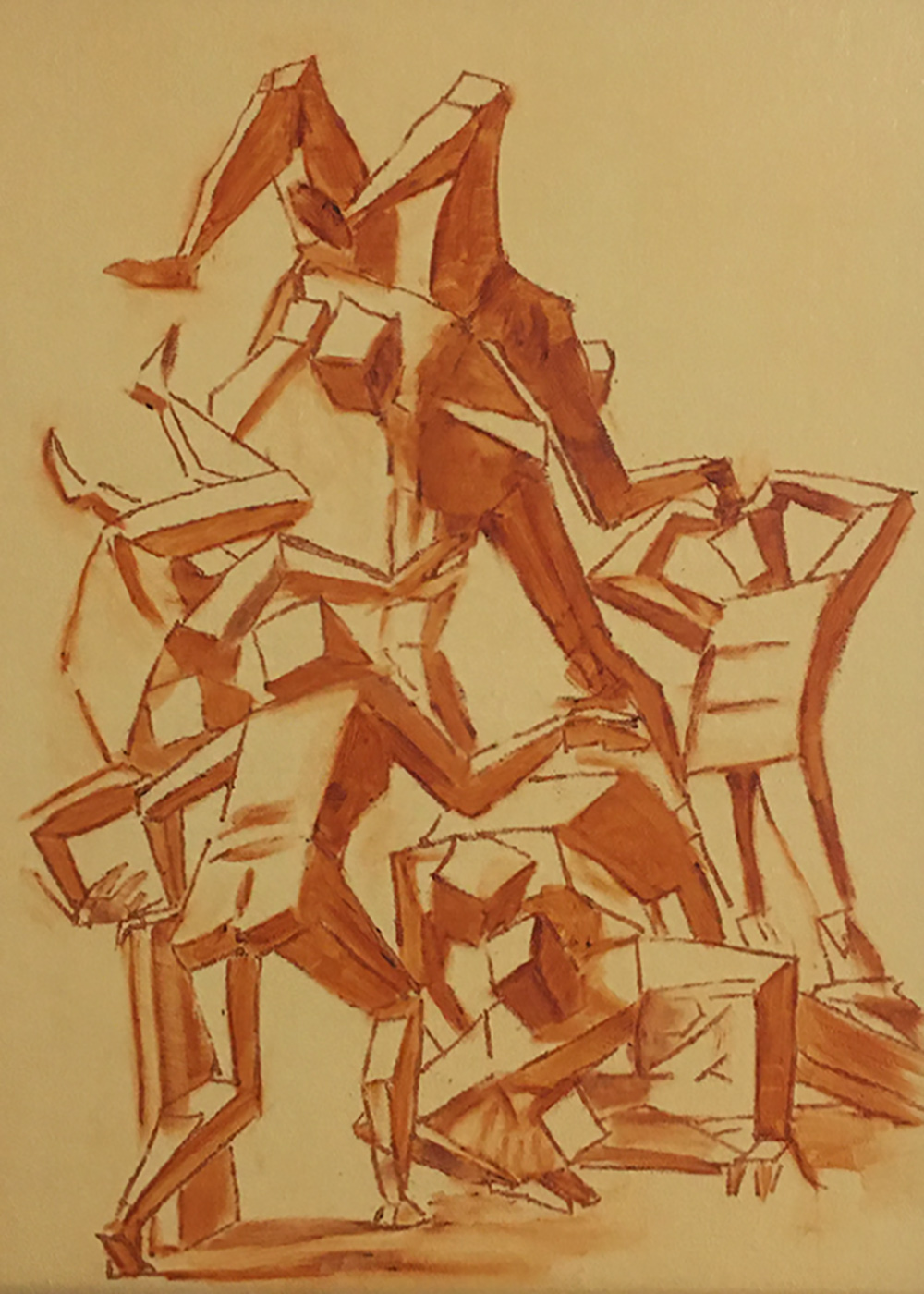
Luca Cambiaso (1527-1585) was a Genoese School painter and draughtsperson. He visited Rome at least twice and Michelangelo was a powerful influence on the massiveness of his figures, although a softness of modeling perhaps has more in common with Correggio. Because some of his figures are constructed using simplified cubic shapes, they look remarkably modern.