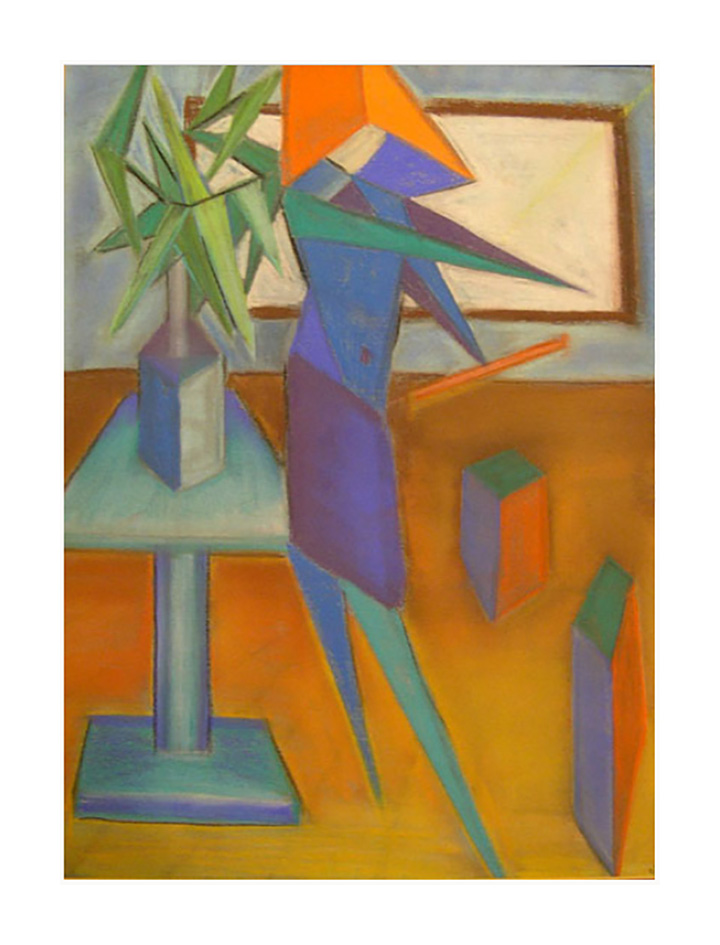
This self-portrait in pastel, now lost, was my vision of myself as an emerging artist in 1978.
This collection showcases work Amy Ione created between 1970-1979.
Since the purpose of this website it to archive Amy Ione’s work from the 1970s to the present, both successful and less successful work is displayed. The website chronology is sorted by decades and pieces are not further sorted by date within each decade.
For more information on any of the shown works, the caption below the painting is linked to details for that specific piece or send an email.
This self-portrait in pastel, now lost, was my vision of myself as an emerging artist in 1978.
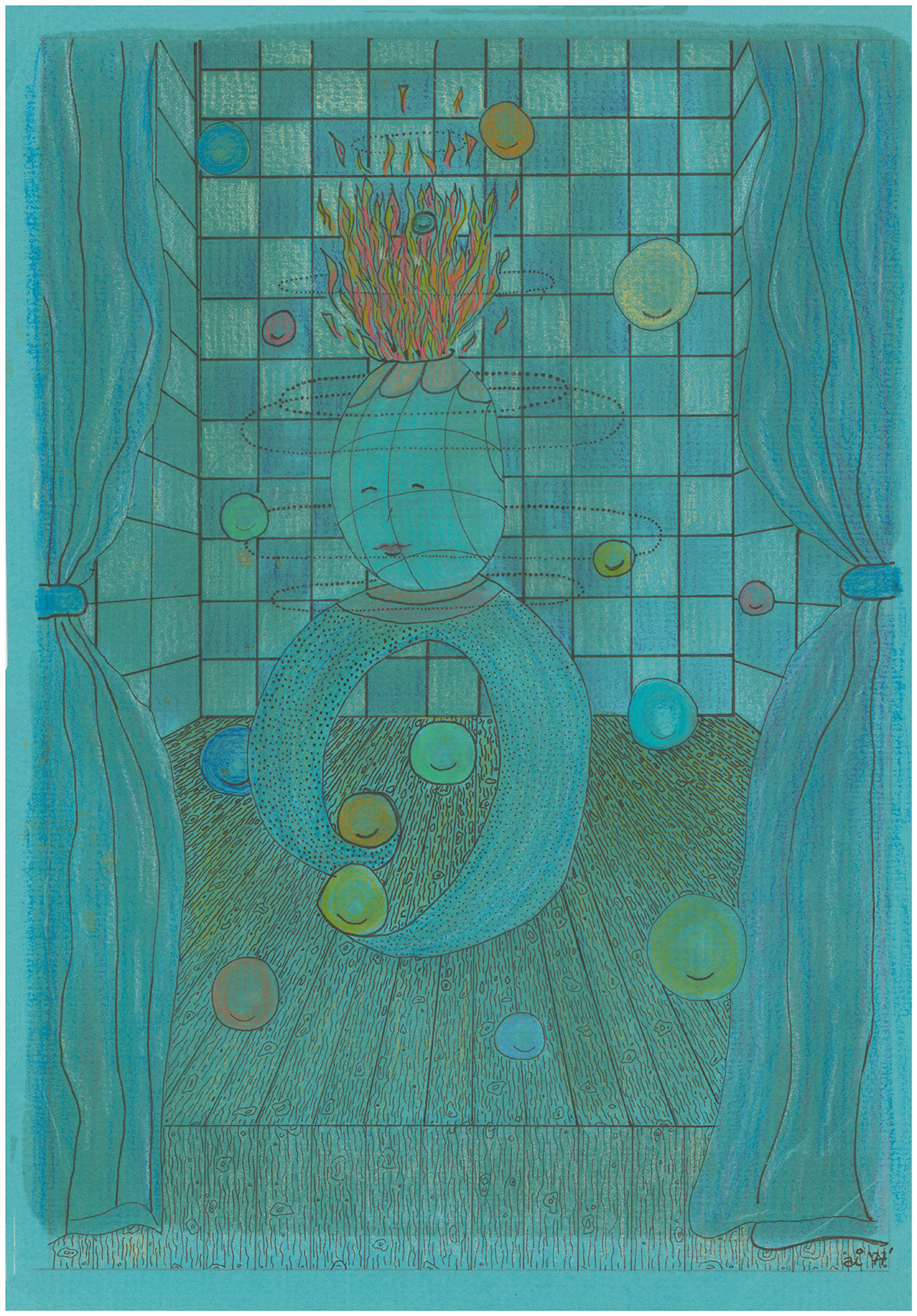
This carefully staged, dreamlike interior merges theatrical space, symbolic imagery, and an abstracted dancing figure. Executed in colored pencil and ink, the drawing balances delicacy of line with a restrained yet luminous palette dominated by cool shades of blues, punctuated by warmer accents. The blues are accentuated by my use a paper that is both turquoise colored and textured.
Continue reading “The Dance (on textured turquoise paper) (1977)”

This mixed media piece (prismacolor and ink) was put together in Ann Arbor, Michigan when I there to participate in Polly’s wedding. It records a conversation with Polly’s mother before the wedding.
A free form abstraction drawing, like many of my Fantasy painting of this time, the perimeter is irregular and was intentionally cut this way to accentuate the image’s dynamic.
Continue reading “Polly’s Wedding, 1978”

Free form abstraction drawing created with prismacolor and ink. Like many of the Fantasy painting of this time, the perimeter is irregular and was intentionally cut this way to accentuate the image’s dynamic. Polly’s Wedding is another work in this series, although the irregular perimeter is not as pronounced.
Continue reading “Going Home (1977), a free form abstraction”
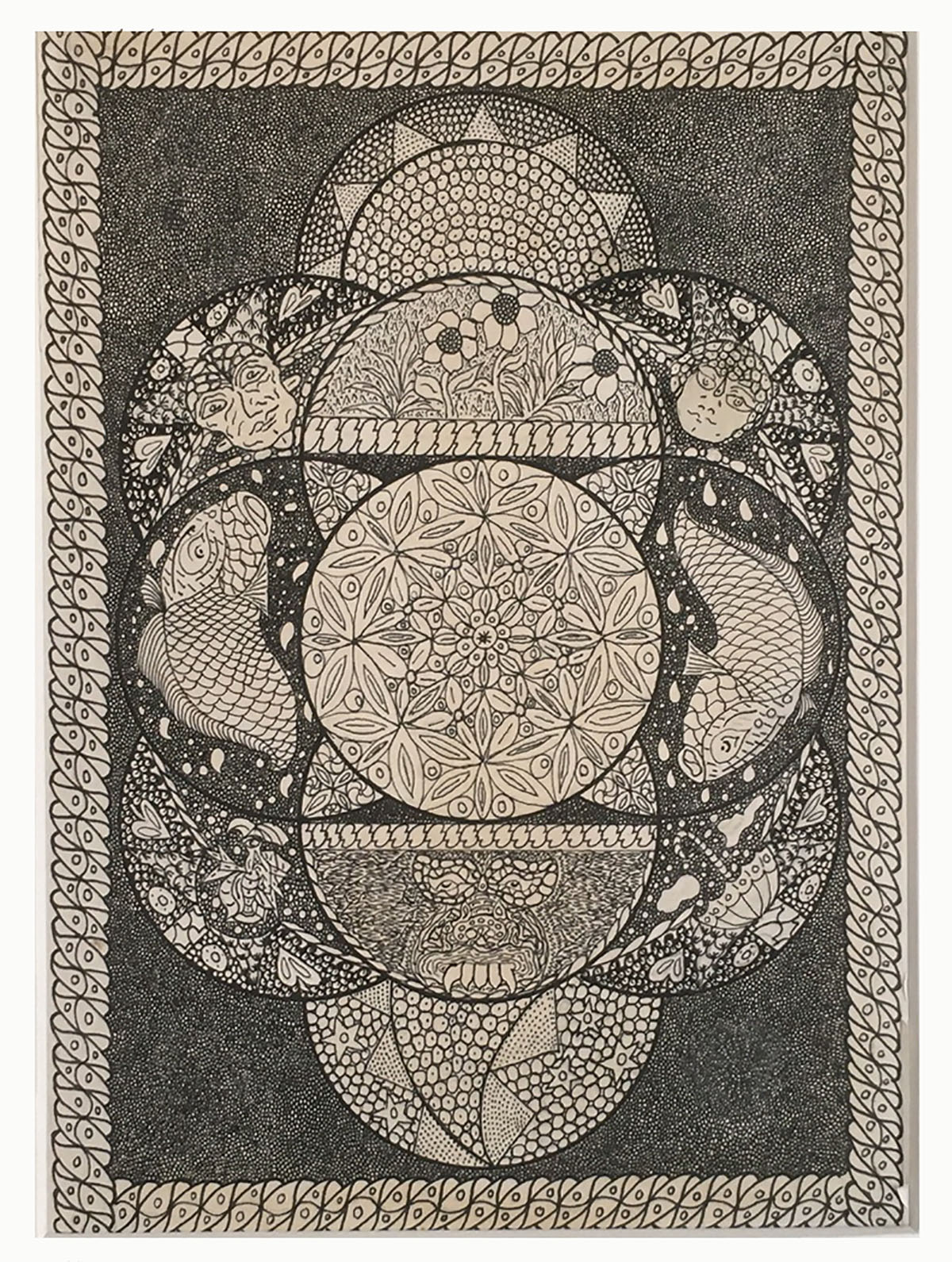
The First (Pisces) (1973) was conceived during the 1970s and can be associated with the contemporaneous explorations of astrology, mandalas, and esoteric systems done by many artists and in Western psychology generally during this decade. An ink drawing, this mandala was more seminal in my development as an artist in terms of process than in terms of the kinds of idea systems it evokes.
The three process elements of note are (1) the background texture; (2) a patched section—born of an accidental ink spill— on the right, and near the edge of the circle with the beast-like face; and (3) the black-and-white contrast. Continue reading “The First (Pisces)”

A selection of stationery designs, printed on card stock. Each was designed so that it could be folded and put in the mail.
Date: 1974
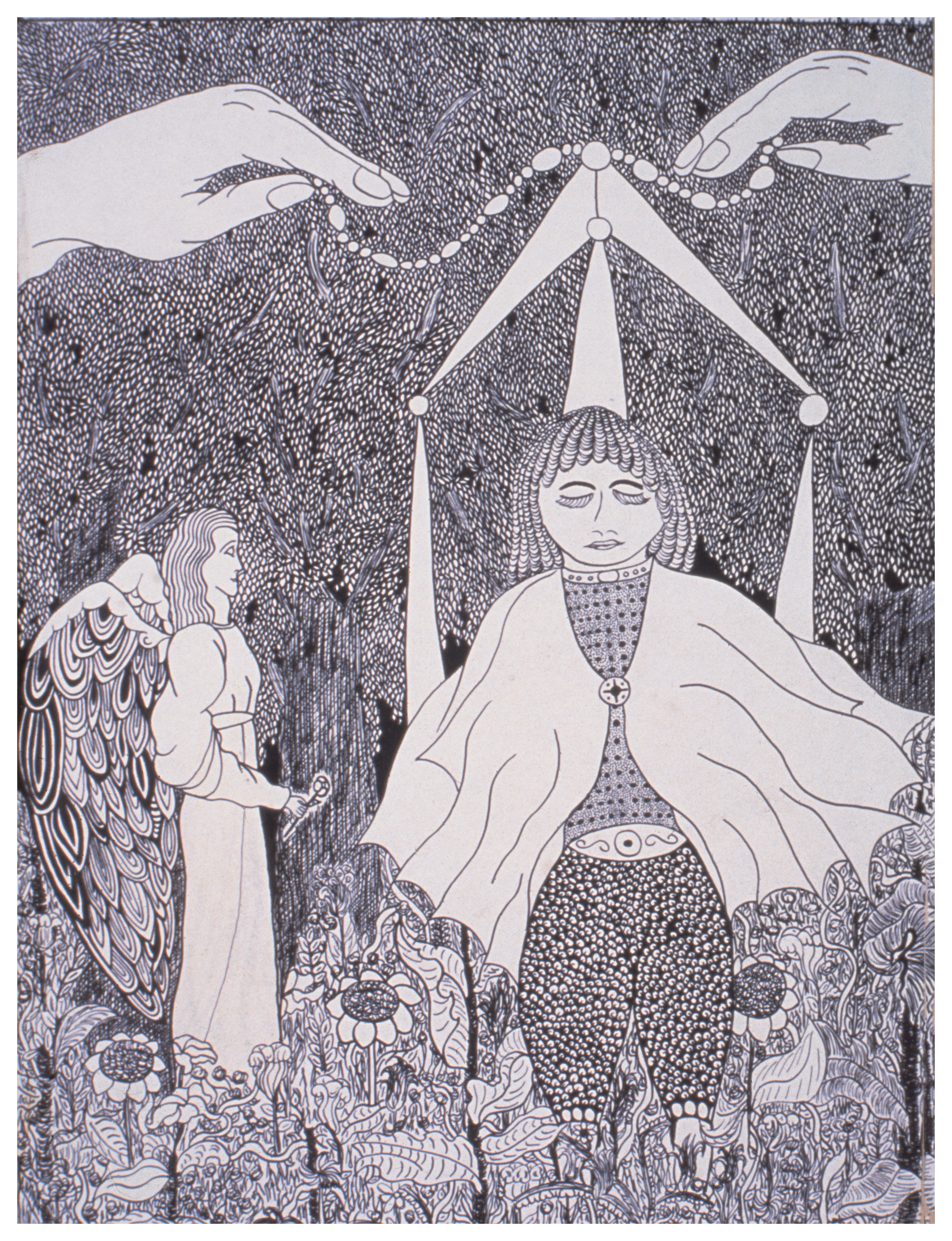
Overall, Puppeteer suggests a puppeteer, a person who manipulates an inanimate object called a puppet to create the illusion that the puppet is alive. It presents this puppeteer as a solitary, invisible figure orchestrating within a pictorial space that suggests some kind of stage.
The theme and style drew on my early 1970s engagement with Aubrey Beardsley’s graphic work, particularly the drawings he did for Salomé. Apparent similarities include the Puppeteer’s flatness; the use of line, pattern and ornament to delineate a narrative that evokes design more than it does realism; and the use of costume and texture to illicit different emotional registers. There are also echoes of Art Nouveau in this early work, a style Beardsley adapted into his high-contrast black-and-white style. Continue reading “Puppeteer (1973)”