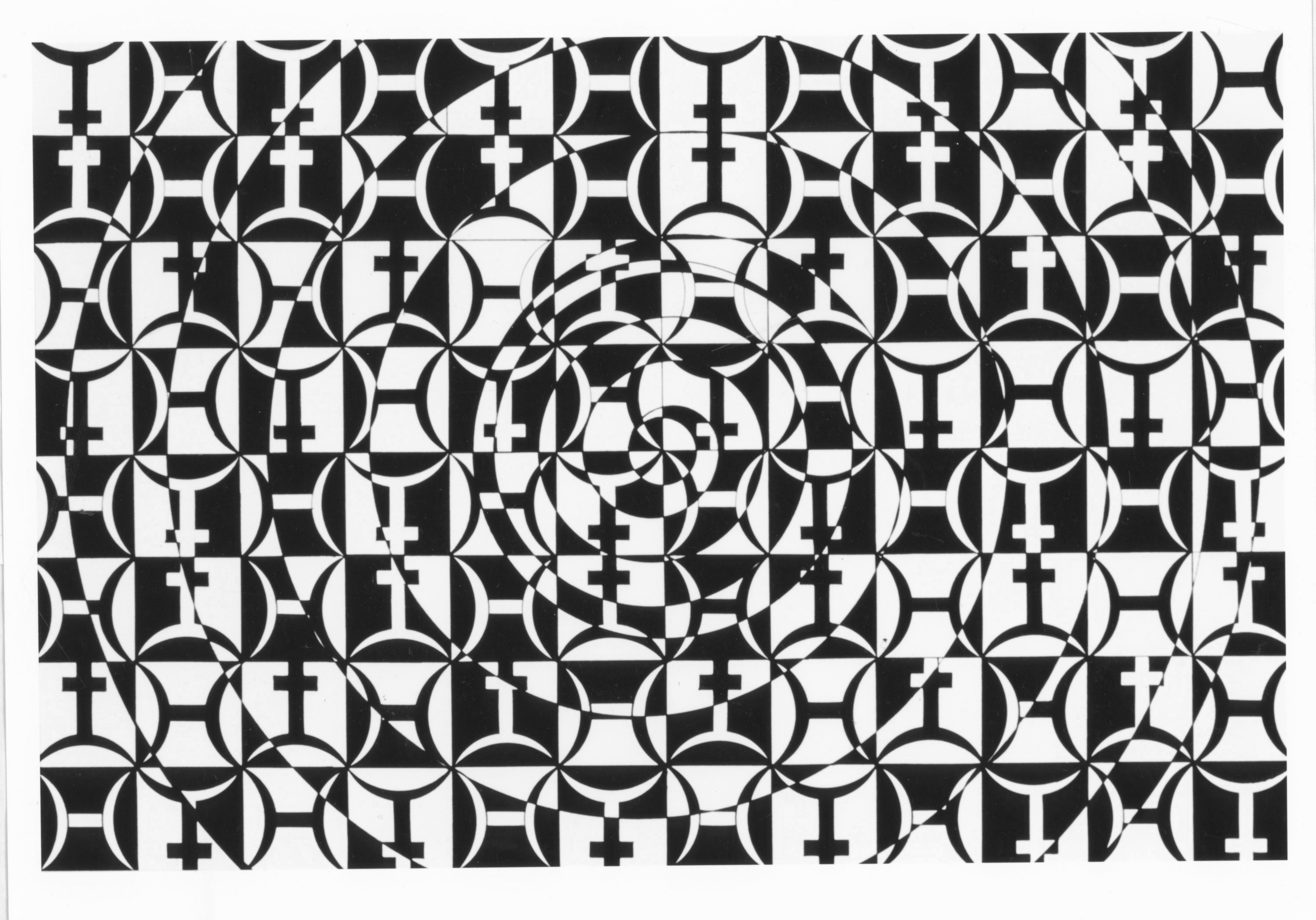
Logo from the San Francisco Civic Arts Center poster on the Michael S. Bell Visual Art Access brochure. Date: 1987 Continue reading “Brochure: Visual Art Access Logo”
Logo from the San Francisco Civic Arts Center poster on the Michael S. Bell Visual Art Access brochure. Date: 1987 Continue reading “Brochure: Visual Art Access Logo”

This Hyperbolic Surface sculpture was constructed out of paper in 2001 with Christopher W. Tyler.
Connecting regular 7-sided polygons (heptagons) together to form a surface results in a geometry that cannot exist in flat (Euclidean)
space. Instead, it creates a regular tiling of the hyperbolic plane. Specifically, the arrangement where three heptagons meet at each vertex
forms the heptagonal tiling with Schläfli symbol. Continue reading “Hyperbolic Surface by Christopher W. Tyler and Amy Ione”
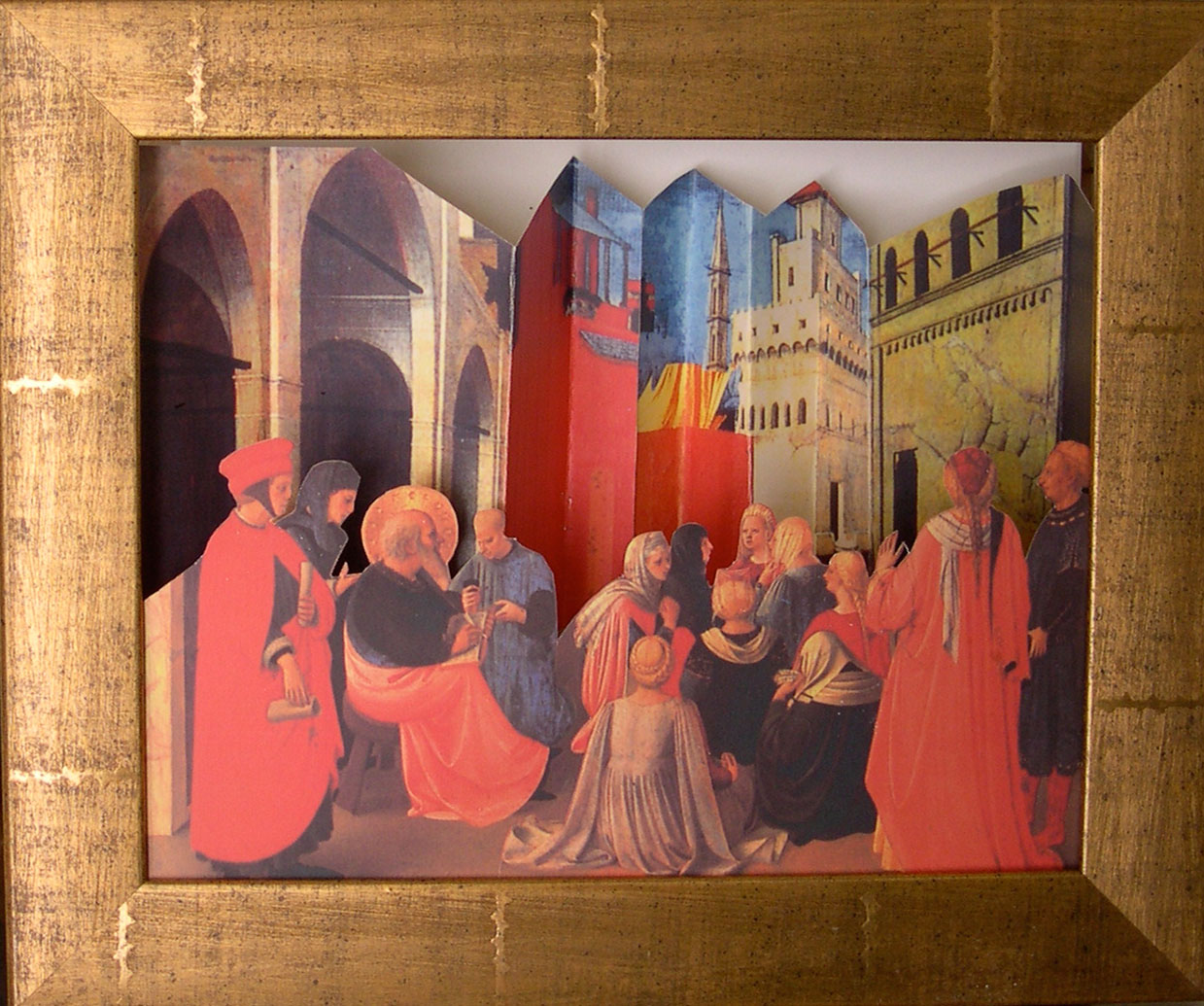
This piece of boxed art is an homage to Fra Angelica’ Linaiuoli Tabernacle: Peter Preaching with Mark. (Predella. 1433. Tempera on panel. 39 x 56 cm. Museo di San Marco, Florence, Italy).
This piece was designed to create a depth illusion. To see illusion the viewer needed to close one eye and move the head.
Continue reading “Frangelic by Christopher W. Tyler and Amy Ione”
Leonardo da Vinci: An Untraceable Life by Stephen Campbell. Princeton University Press, Princeton, NJ, 2025. ISBN: 9780691193687. (Reviewed by Amy Ione, Leonardo, Volume 59, No. 2, pp. 201-204, 2026). PDF
With Peter Bradley directed by Alex Rappoport. Icarus Films, Brooklyn, NY, U.S.A., 2024. 86 mins., col., closed captioned. DVD. Distributor’s website: https://icarusfilms.com/if-wpbrad/. (Reviewed by Amy Ione, Leonardo, Volume 59, No. 1, pp. 93-95, 2026). PDF
Marguerite’s Theorem (Le Théorèm de Marguerite) directed by Anna Novion. Icarus Films, Brooklyn, NY, U.S.A., 2024. 115 minutes, color, French / English subtitles. Distributor’s website: https://icarusfilms.com/di-mtheor. (Reviewed by Amy Ione, Leonardo, Volume 58, No. 6, pp. 657-670, 2025). PDF
Frank Malina: Light Art and Scientific Abstraction edited by Camille Fremontier. Published with RCM Galerie, 2025. 252 pp., illus. ISBN: 978-2-37896-558-7. (Reviewed by Amy Ione, Leonardo, Vol. 59, No. 1, pp122-124. 2025) PDF
Plasticity in the Life Sciences by Antonine Nicoglou. University of Chicago Press, Chicago, IL, USA, 2024. 300pp. illus. ISBN: 978-0-22-683714-7; 978-0-22-683716-1. ((Reviewed by Amy Ione, Leonardo, Volume 58, No. 3, pp. 305-307, 2025). PDF

Pictures of Naxi (full name Anaxamandra) helping in the studio, roaming on a fence, and sharing as only a cat can.
 This book offers a profound assessment of our ever-evolving view of the biological brain as it pertains to embodied human experience.
The strength of Art and the Brain certainly lies in intriguing theoretical discussions of framing structures and visual foundations through the deep historical contexts of the neurosciences.
Frank W. Stahnisch ( Journal of the History of the Neurosciences, 26:4, 436-437,
DOI: Journal of the History of the Neurosciences, 26:4, 436-437.

The first in detail account that relates the development of visual images to innovations in art, communication, scientific research, and technological advance.
In a 2005 review of Innovation and Visualization: Trajectories, Strategies, and Myths, John Danvers wrote:
“It is this kind of historical insight and connectivity which makes Innovation and Visualization such a stimulating text to read. With its combination of scholarship and lucidity, fascinating information and provocative argument, this lively and intelligent book will be welcomed by the academic community and by many general readers, who will enjoy Ione’s eloquent cross-fertilisation of ideas and her healthy disregard for disciplinary boundaries.” [Full review here]
• • • • •
Amy Ione
Title: Innovation and Visualization: Trajectories, Strategies, and Myths
Date: 2005
Publisher: Rodopi
ISBN: 9042016752
Catalog Number: 24148
 Nature Exposed to our Method of Questioning explores how we create our cultural assumptions about nature, culture and ourselves.
Continue reading “Nature Exposed to Our Method of Questioning”
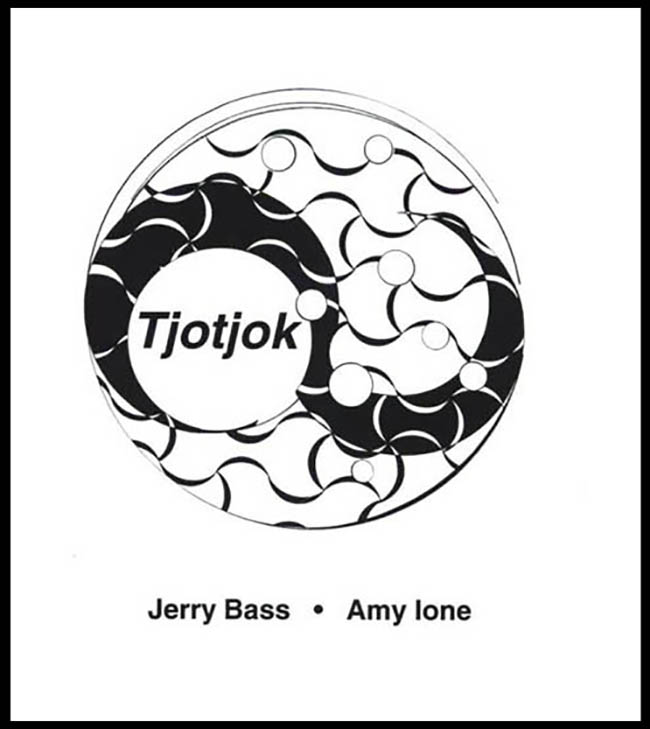 A collection of 86 poems by Jerry Bass, enhanced by Amy Ione’s original artwork.
Continue reading “Tjotjok: Poetry by Jerry Bass. Illustrated by Amy Ione.”

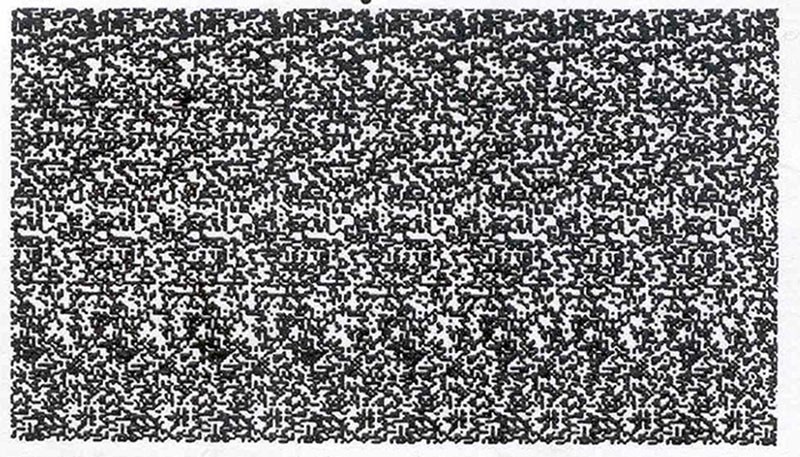
Two autostereograms. One was created intuitively by Amy Ione using colored paper rectangles gathered using a punching device. The other is by Christopher W. Tyler, who invented the autostereogram.

Two images also by Amy Ione and Christopher Tyler. One, on the left, is a black and white ink painting (on paper) that uses the astrological symbol for Pisces. The other is a Matrix algebra version that was computed in MatLab by Christopher W. Tyler