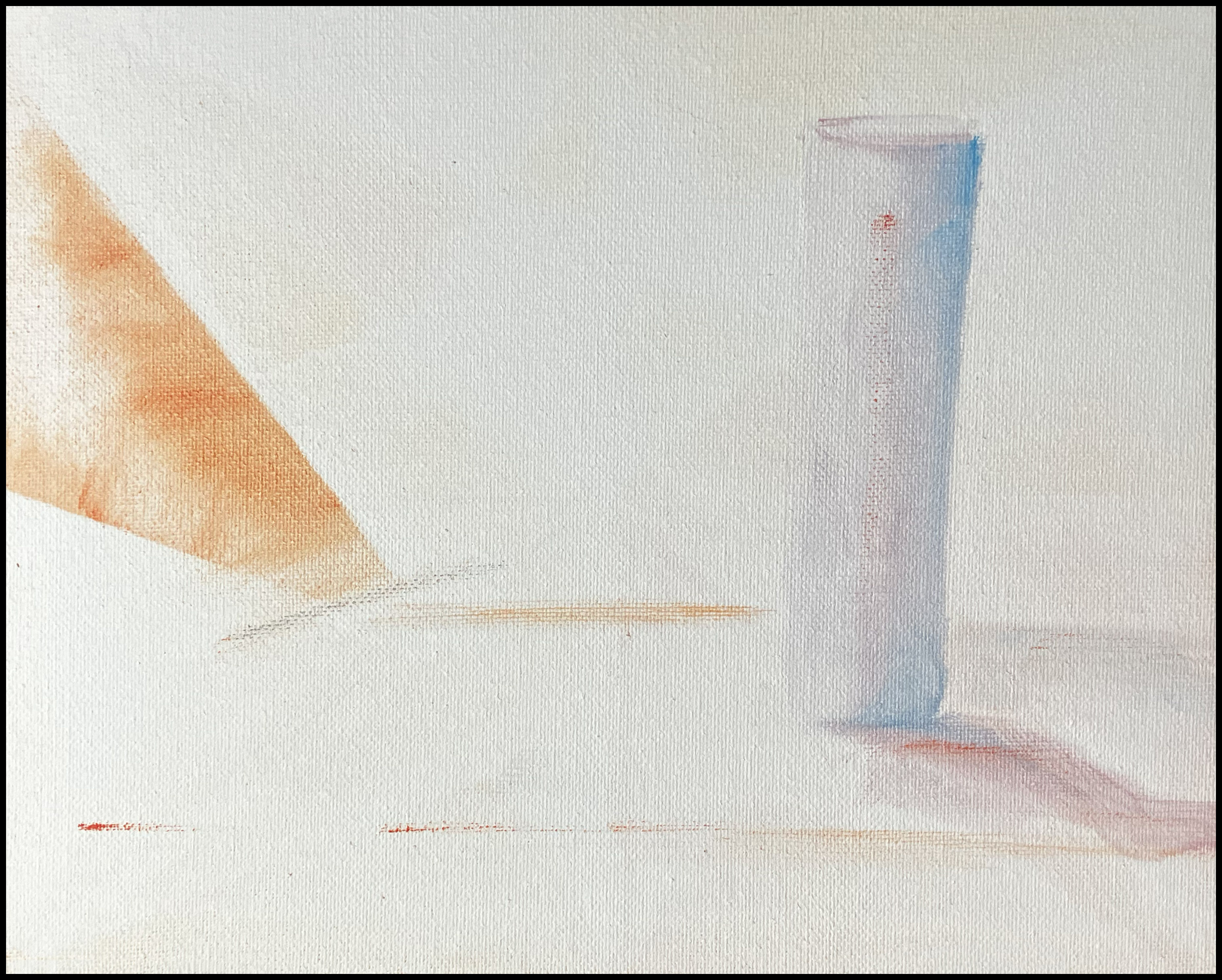
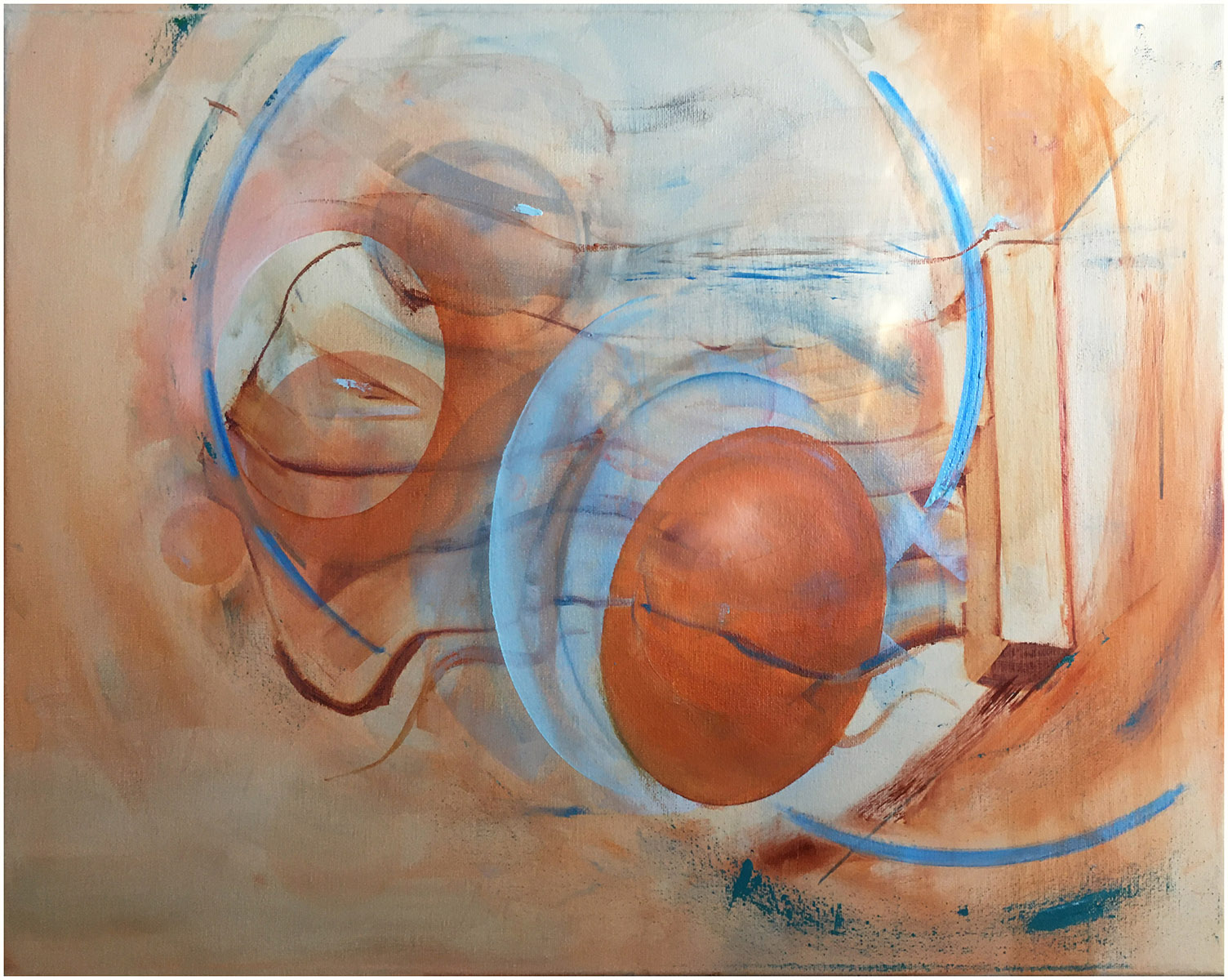
Amy Ione
Title: Sketch (35665)
Date: 2024
Medium: Oil on canvas
Dimensions: 10 x 8 x 0.75 inches (unframed)
Unsigned
Catalog Number: 35665 Continue reading “Sketch (35665) (2024)”
This section showcases Amy Ione’s paintings from throughout her career. Other tabs sort by decades, topics, time periods, and so forth.
Amy Ione
Title: Sketch (35665)
Date: 2024
Medium: Oil on canvas
Dimensions: 10 x 8 x 0.75 inches (unframed)
Unsigned
Catalog Number: 35665 Continue reading “Sketch (35665) (2024)”

Rainy Day Monday is a small, compact painting created with both oil and ink. This combination juxtaposes some measure of painterly richness (from the oil) with sharper, linear, and tighter elements (from the ink). Perceptually, interweaving the media this way offers a surface with textural contrast; it is one in which boarder color fields play against the fine detail.

This unfinished composition on Masonite offers a glimpse of my painting process. The work was begun before I began my Neuroscience and Art book, which was published in 2024. This piece was set aside during the writing process and still awaits completion.
Circles—shapes associated with harmony and balance—form a central element of my visual vocabulary. While not the case here, at least not in this point of the image’s creation, in many of my works circles appear alongside ellipses. This is unsurprising given that an ellipse can be described as an elongated circle. In other words, the ellipse shape generalizes a circle, which is a special case of an ellipse. Continue reading “Unfinished Circles”
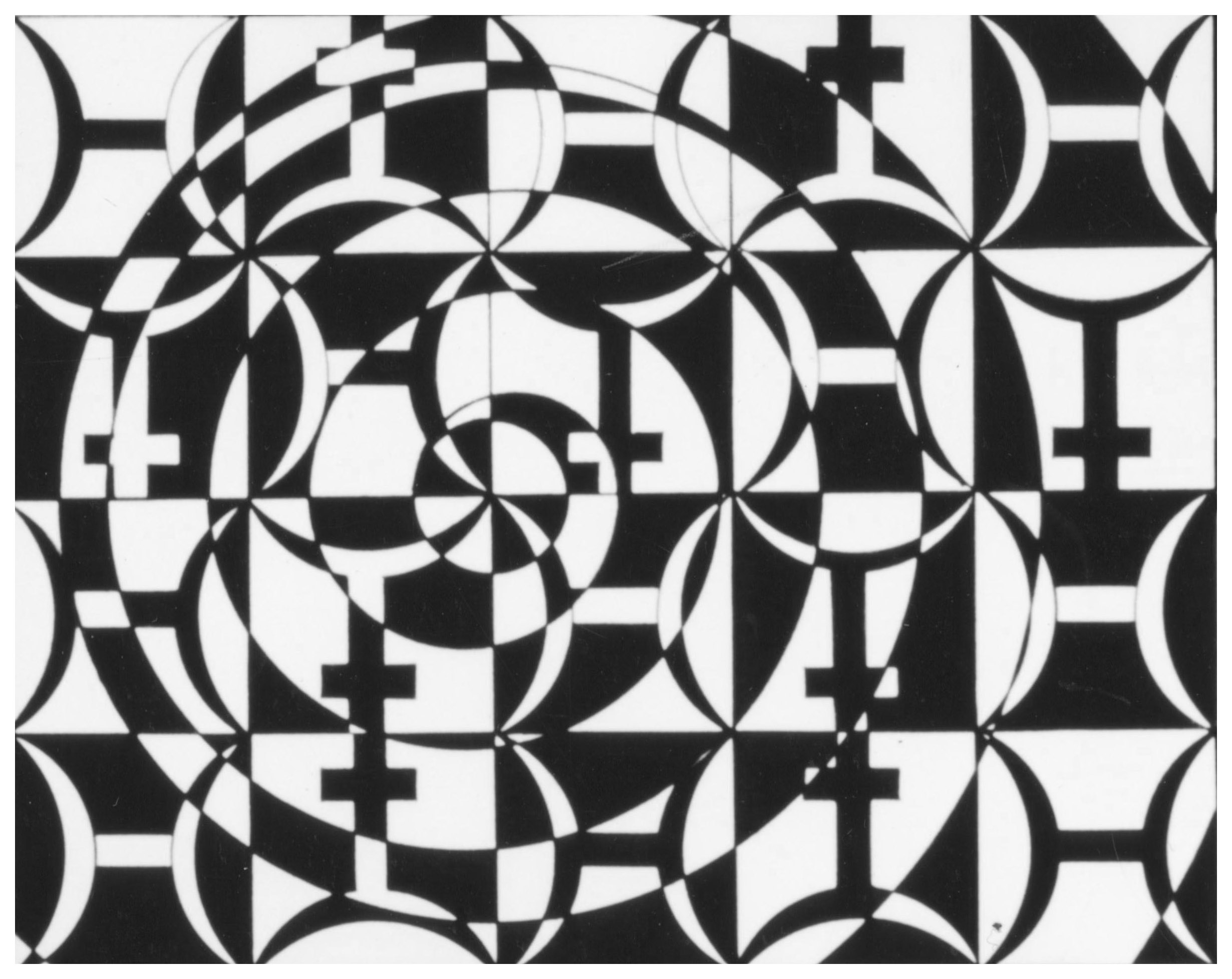
Pisces (1985) was a pivotal piece. It incorporates the Pisces symbol into the composition, and is not a narrative work in any way. Its vibrancy comes about due to the use of spirals and patterning—and it built on my discovering that creating lines with different sized pen widths added a perceptual musicality. This discovery is discussed on The First (Pisces) page.

Reflections on Water #2 continues the perceptual inquiry begun in 1991 with the Reflections on Water #1 painting. It also shifts the emphasis by re-positioning transparency, overlay, and compositional variation.
Executed on hot-pressed watercolor paper, the second of the two Reflections on Water paintings was conceived on a smoother surface. Thus, it demanded a different approach: layered color washes and varied line widths create resonance without relying on textural grain. In other words, in Reflections on Water #2 the clarity and vibrancy derive from the controlled transparency of acrylic overlays, producing luminous effects that evoke water’s shifting reflections.
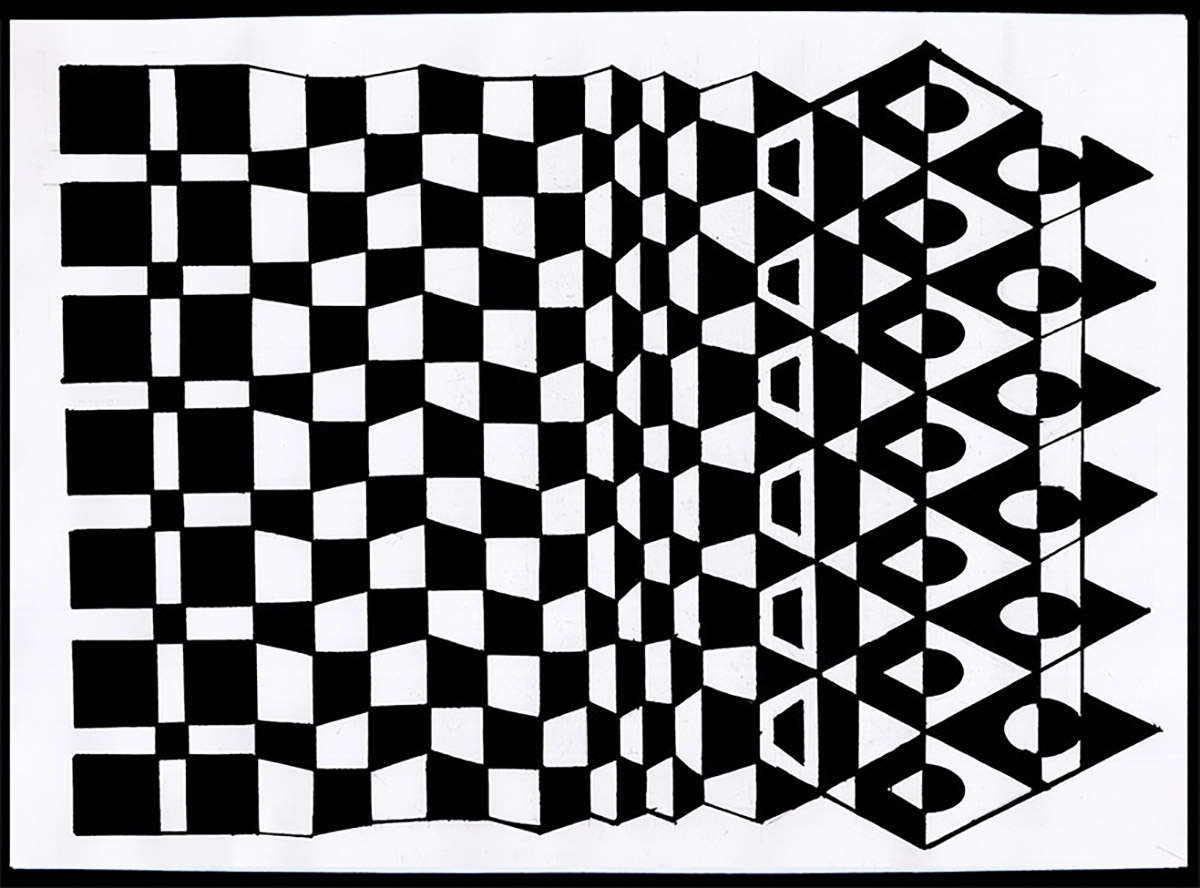
This small, intimate work foregrounds “mutation” as both subject and method. It began with a vertical line of squares and with slight changes on the vertical axis, the pattern was transformed into an open column of triangles at the end. Overall, the piece expresses a noticeable change in character, appearance, function or condition on a 2-dimensional plane; a metamorphosis that adds a perceptual dynamic to the black-and-white geometries. Continue reading “Mutation Study #1 (2018)”
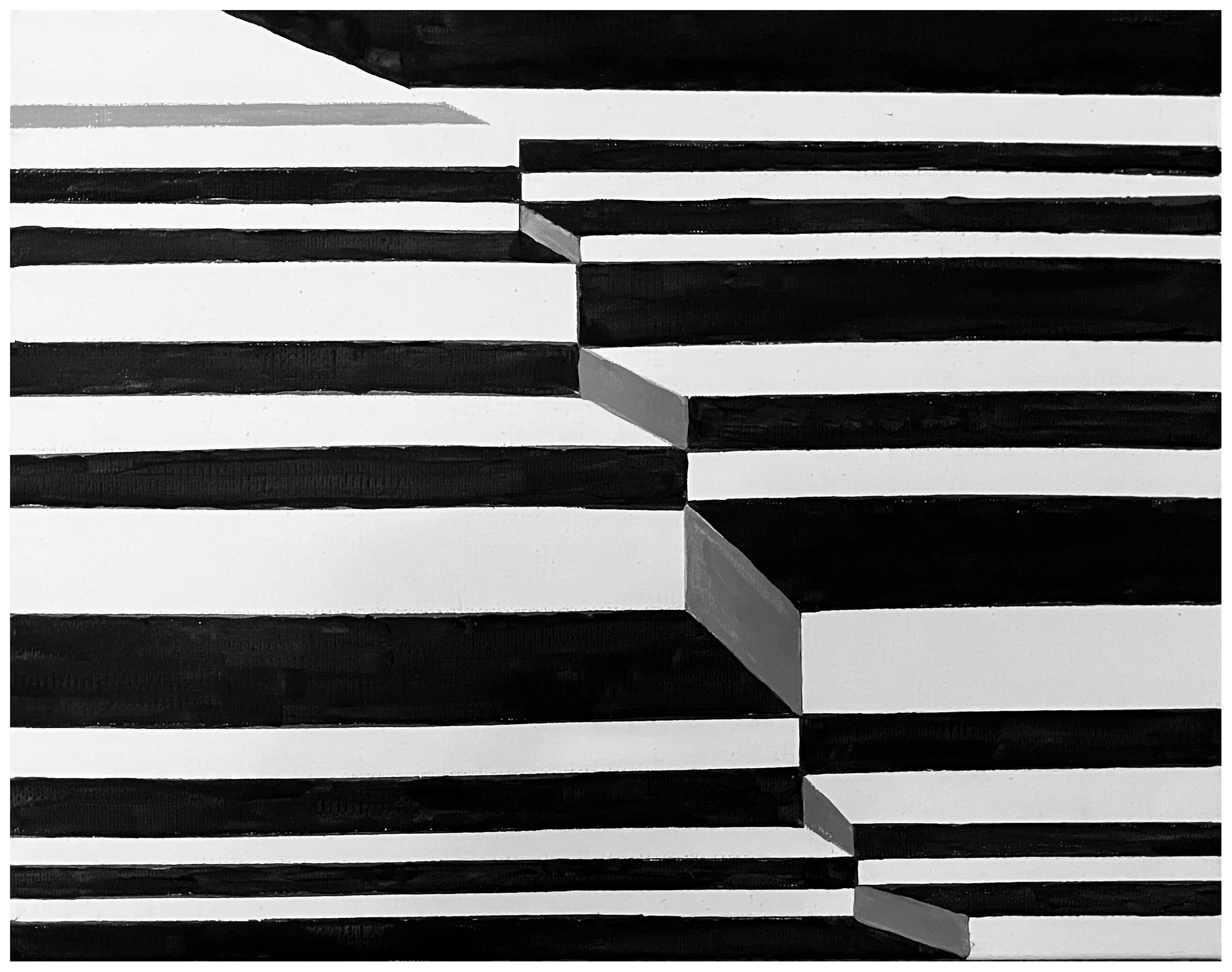
This is a perceptual experiment intended to convey the social dissonance in 2025. In it, the black, white and shades of gray play off the horizontal lines and a diagonal cue to create an optical illusion. At the same time, they point to the various ways in which life, society, and even ideas about what reality is are uncertain or unpredictable. Continue reading “Uncertainty and Dissonance (2025)”

Space Study #1 exemplifies my ongoing investigation into the intersection of art, science, and visual cognition. The painting’s layered hues—derived from a limited palette of red, green, and white—demonstrate how subtle shifts in chromatic balance can generate a sense of depth and spatial ambiguity. Continue reading “Space Study #1 (2002)”
A Modern Creation Myth was titled after completion. It is not a narrative piece, but rather an image of vibrant, abstract and elemental forms, combined with its ethereal color transitions. When finished, the overall composition struck me as an expression evocative of creation myths. Continue reading “A Modern Creation Myth (2021)”

Penrose Tiling #1 explores visual complexity and perceptual rhythm. Rendered in oil on an oblong canvas, Penrose Tiling #1 is a tessellation of rhombus-shaped units arranged in a Penrose tiling—a non-periodic pattern. The composition overall resists repetition while maintaining structural coherence. One visual element of note is how the elongated horizontal format enhances the sense of spatial drift, as the eye navigates the interlocking forms and their directional cues. Continue reading “Penrose Tiling #1 (2013)”