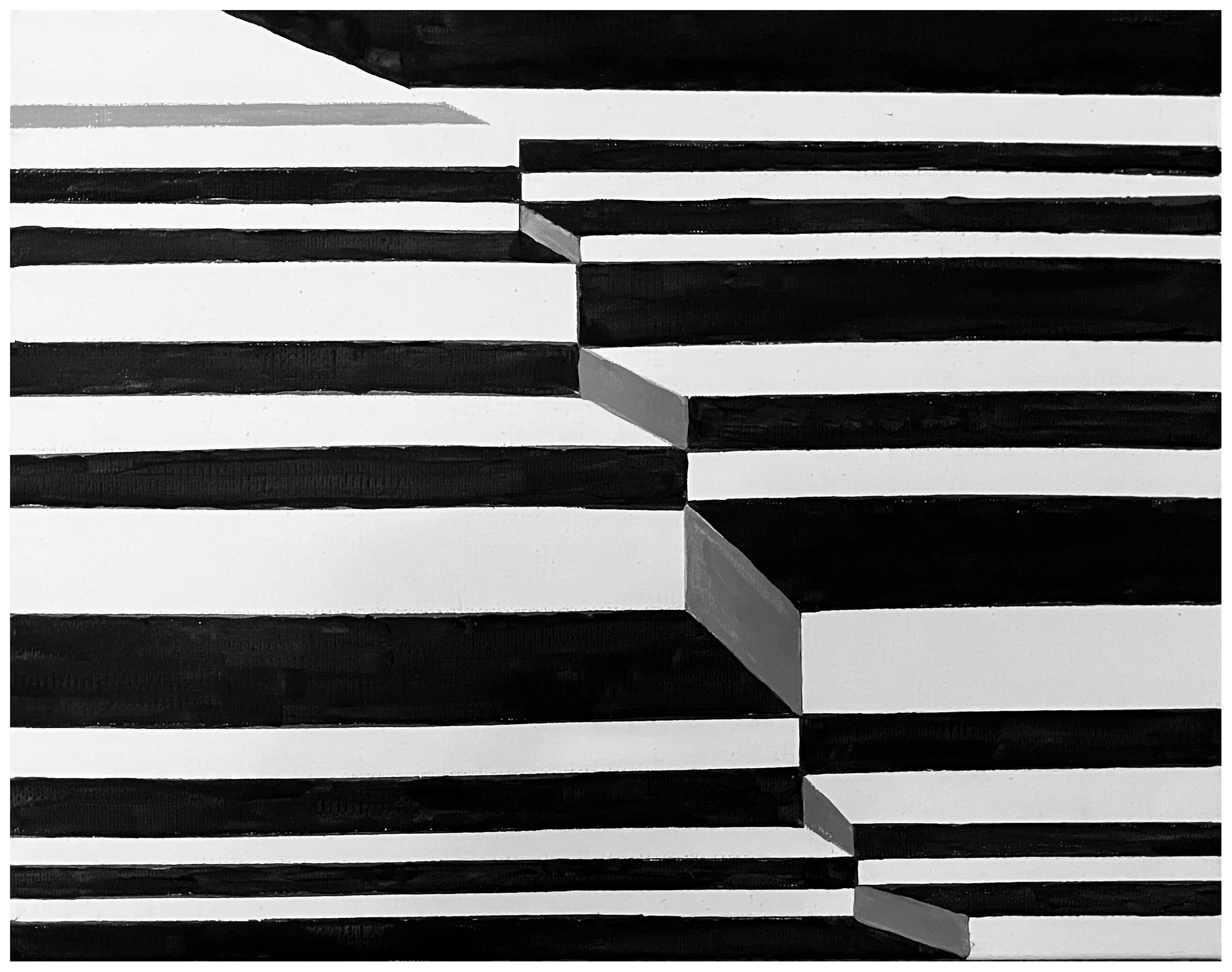
This is a perceptual experiment intended to convey the social dissonance in 2025. In it, the black, white and shades of gray play off the horizontal lines and a diagonal cue to create an optical illusion. At the same time, they point to the various ways in which life, society, and even ideas about what reality is are uncertain or unpredictable.
More specifically, the stark black-and-white palette of Uncertainty and Dissonance offers an optical disjunction (and an optical illusion) that is conveyed through how the rhythmic horizontal stripes evoke contradictions, stability, repetition, spatial ambiguity, and perceptual tension. As a result, this composition challenges the reliability of visual cues.
Uncertainty and Dissonance also evokes how clarity and distortion coexist. The black-and-white design of this painting suggests a formal, visual logic. At the same time, its asymmetry has a dissonant emotional resonance that defies an aesthetic formal presentation. Still, the composition’s perceptual tension references Gestalt psychology, a twentieth century framework that proposes our perceptions are shaped by the entire configuration of stimuli.
Formally, this work is also in line and contradictory to perceptual abstraction in the twentieth and twenty-first centuries. The work’s central zigzagging rupture recalls Bridget Riley’s visually, rhythmic paintings, which similarly manipulate spatial depth and viewer orientation through calibrated contrast and repetition. Unlike Riley’s work, however, Uncertainty and Dissonance’s jagged vertical fissure introduces a more abrupt, architectural disturbance and a break with Riley’s more meditative visual aesthetics.
Similarly, Victor Vasarely’s geometric constructions offer a sense of shifting dimensional planes, Uncertainty breaks from this as well, through its conceptual dissonance, which defies Vasarely’s more systemic harmony.
Sol LeWitt, especially his wall drawings and grid-based compositions, offers another point of reference. Whereas LeWitt’s formal compositions showed an interest in rule-based systems, they also allow for variation and unpredictability. Since Uncertainty and Dissonance’s process was aligned with making a social statement, its dissonance is front-and-center in a broader sense.
One intriguing element of this work is that it also aligns with a range of other artists. For example, references within this work can encompass James Turrell and Robert Irwin due to its perceptual emphasis. Both Turrell and Irwin used light and space to play with perceptual possibilities. Nonetheless, Uncertainty and Dissonance is more graphic and planar. Therefore, its emphasis as well as its emotional and perceptual tenor aligns it with the perceptual light and space impulses and process. At the same time, it projects a different register we viewed.
Given this, it makes sense to add a twenty-first artist to the mix. Early in her career Julie Mehretu’s work was frequently critiqued in terms of how she used layered marks to convey a sense of dynamic complexity and visualize systems in flux, ongoing concerns of mine as well. Later, her stressed on urban and social concerns was more pronounced. The balance between aesthetic and societal elements echoes my conceptual terrain here, and while conceiving this piece.
• • • • • •
Amy Ione
Title: Uncertainty and Dissonance
Date: 2025
Medium: Acrylic on canvas
Dimensions:12.25 x 9.5 x 0.75 inches (unframed)
Signed: On back
Catalog Number:35622
Exhibitions
2026
Color, Form, Dynamics. Biafarin, August 11-October 11