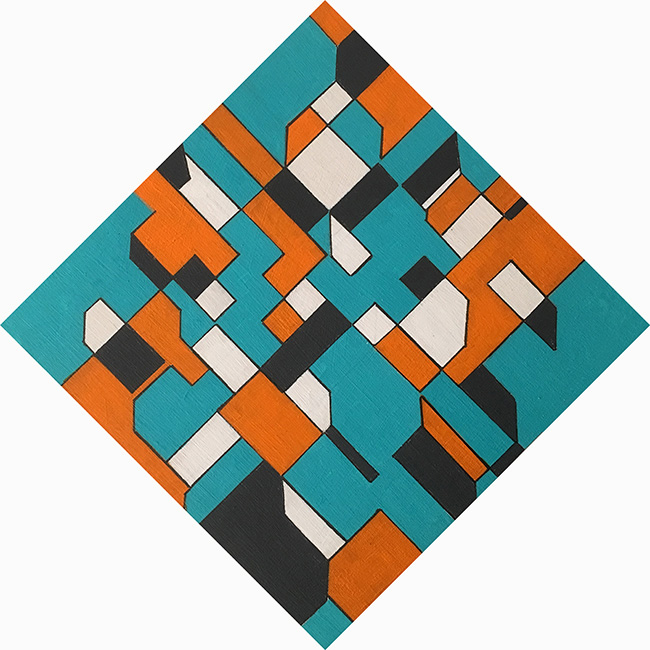
Homage to Paul Klee (Blue Night) #1 is an intimate tribute to Paul Klee’s 1937 Blue Night (Blaue Nacht) painting. Like Klee’s work, this piece reflects a fusion of abstraction and poetic nuance. One noteworthy quality is how the homage to Klee asserts a contemporary rhythm through its presentation of a geometric composition built entirely from straight lines and angular forms.
In Homage to Paul Klee (Blue Night) #1 the teal, orange, cream, and black shapes interlock like notes on a staff or keys on a piano keyboard. What may strike some as a rigid geometry on close viewing shows the artist creates a syncopated rhythm across the diamond-oriented square, with colors shifting in unpredictable patterns that suggest musical intervals.
The straight-edged forms not only recall Klee in terms of process but also mirror his background as a trained musician. This training informed his understanding of rhythm, repetition, and variation. Although this homage is not as playful as his original composition, it does mirror his process of delineating a work as it is freely shaped and alludes to his fascination with how one can manipulate abstract possibilities in both art and music.
The translation of musical process into visual terms in this homage work was accomplished through systematic color placement and directional shifts. Each angular shape functions like a distinct note contributing to an overall harmonic structure. The earliest stage was mapped out using a grid,. The second step was creating a mutating pattern within the grid. Then systematically coding led to a form with dissimilar color shapes. This result was further manipulated and enhanced through perceptual engagement.
This approach mirrors Werner Haftmann’s statements in his book, The Mind and Work of Paul Klee (1954), where he pointed out that Klee taught his students: “Not form, but forming, not form as final appearance, but form in the process of becoming, as genesis.”.
On close viewing of the Homage to Paul Klee (Blue Night) #1, subtle shifts in tone and texture are revealed. These echo the quiet dynamism of Klee’s Blaue Nacht. Moreover, like Homage to Paul Klee (Blue Night) #2, its diptych partner, this painting demonstrates how a musical methodology can manifest through formal vocabularies. Both panels, conceived on 8-inch panels, evoke Klee’s lyrical sensibility. What separates the two homages is that Homage to Paul Klee (Blue Night) #1 is more staccato and architectural, while Homage to Paul Klee (Blue Night) #2 is more legato and organic.
In summary, the Homage to Paul Klee (Blue Night) #1 balances precision with spontaneity and echoes Klee’s belief that art makes something invisible visible.
Klee’s Blue Night (Blaue Nacht) is part of the collection at the Kunstmuseum Basel in Switzerland. It was created in 1937 and is considered one of Klee’s most notable works.
• • • • •
Amy Ione
Title: Homage to Paul Klee (Blue Night) #2
Date: 2018
Medium: Acrylic on wood panel
Dimensions: 8x8x1
Catalog Number: 29345
• • • • • •
See also “Klee and Kandinsky Polyphonic Painting, Chromatic Chords and Synaesthesia” in the Journal of Consciousness Studies, 11, No. 3–4, 2004, pp. 148–58.
• • • • • •
Exhibitions
2026
Color, Form, Dynamics. Biafarin, August 11-October 11