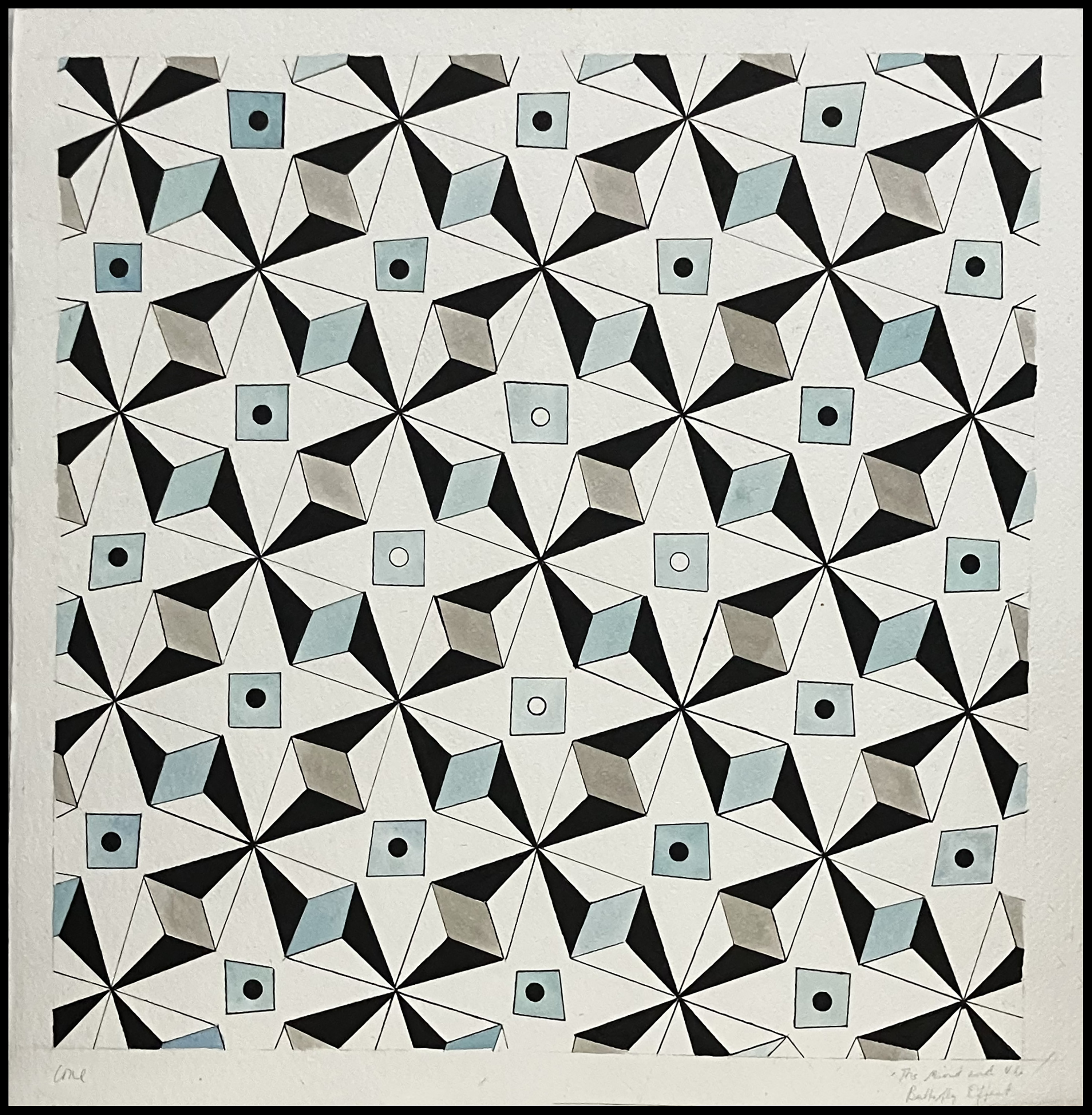
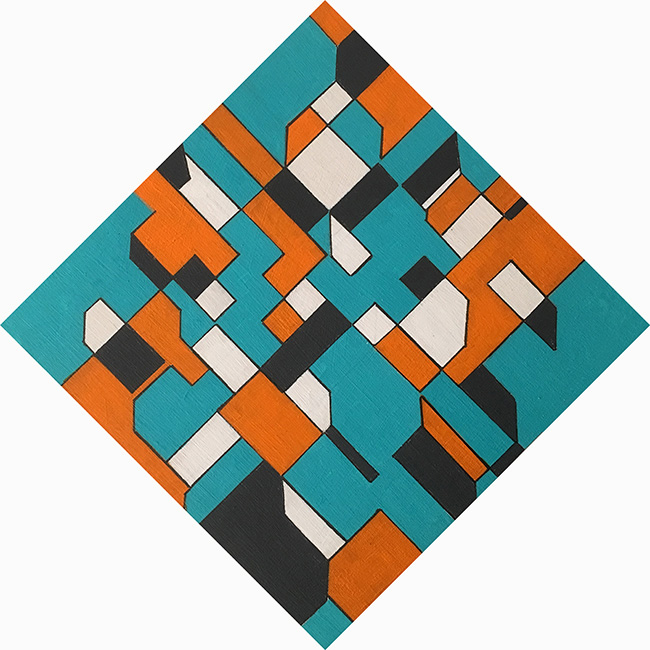
The Mind and the Butterfly Effect brings geometric structure into dialogue with the unpredictability that defines artmaking, cognition, and chaos theory. It takes it title (or conceptual cue) from the “butterfly effect,” the idea that minute variations in initial conditions can cascade into large, unforeseen consequences within complex systems. Initially, the composition reads as regular—anchored by a grid-like scaffolding and a disciplined sense of spatial order. Closer inspection, however, reveals subtle shifts in line weight, chromatic modulation, and the physicality of the ink and acrylic application.
This intimate tribute to Paul Klee’s 1937 Blue Night (Blaue Nacht) is a part of a diptych, with Homage to Paul Klee (Blue Night) #1 comprising the other panel. Both works celebrate Klee’s fascination with how one can manipulate abstract possibilities in both art and music. Therefore, it too reflects a fusion of abstraction and poetic nuance. Together, the two 8-inch panels of the diptych demonstrate how Klee’s musical methodology can manifest through contrasting formal vocabularies, one staccato and architectural, the other legato and organic. Continue reading “Homage to Paul Klee (Blue Night) #2 (2018)”
Homage to Paul Klee (Blue Night) #1 is an intimate tribute to Paul Klee’s 1937 Blue Night (Blaue Nacht) painting. Like Klee’s work, this piece reflects a fusion of abstraction and poetic nuance. One noteworthy quality is how the homage to Klee asserts a contemporary rhythm through its presentation of a geometric composition built entirely from straight lines and angular forms. Continue reading “Homage to Paul Klee (Blue Night) #1 (2018)”
This painting illustrates a strategy for revealing the mechanics of both seeing and feeling. Rather than simply representing the objects that comprise a still life, in this painting the diagonal fractures guide the eye and the repeated angular motifs produce rhythm. Thus, the overall result is a constructed surface, reinforcing the painting’s materiality.
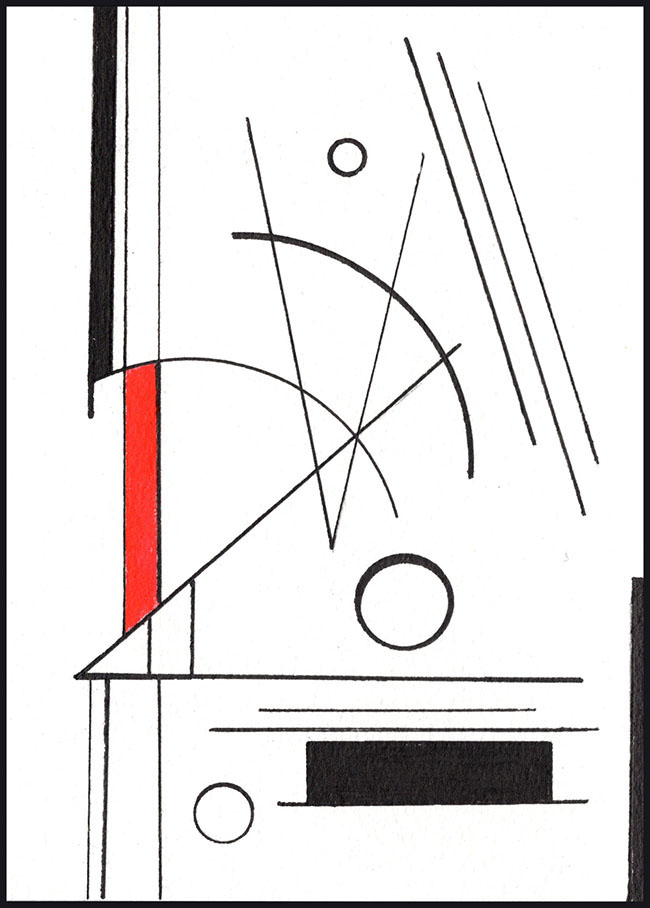
Amy Ione Title:Evocative Red Chord (Greeting Card) Date: 2017 Medium: Ink and acrylic on archival paper Dimensions: 7.25 x 5.25 inches Unsigned: Catalog Number: 26289
This book offers a profound assessment of our ever-evolving view of the biological brain as it pertains to embodied human experience.
Review
The strength of Art and the Brain certainly lies in intriguing theoretical discussions of framing structures and visual foundations through the deep historical contexts of the neurosciences.
Frank W. Stahnisch ( Journal of the History of the Neurosciences, 26:4, 436-437,
DOI: Journal of the History of the Neurosciences, 26:4, 436-437.
Homage to Sol LeWitt (2015) offers an homage to Sol LeWitt’s legacy of conceptual rigor and geometric clarity. The interplay of oil and pencil creates a dialogue between painterly mark making and linear precision, echoing LeWitt’s investigations of structure while asserting my own interest in perception, the power of visual syntax, and artistic process. Continue reading “Homage to Sol LeWitt (2015)”